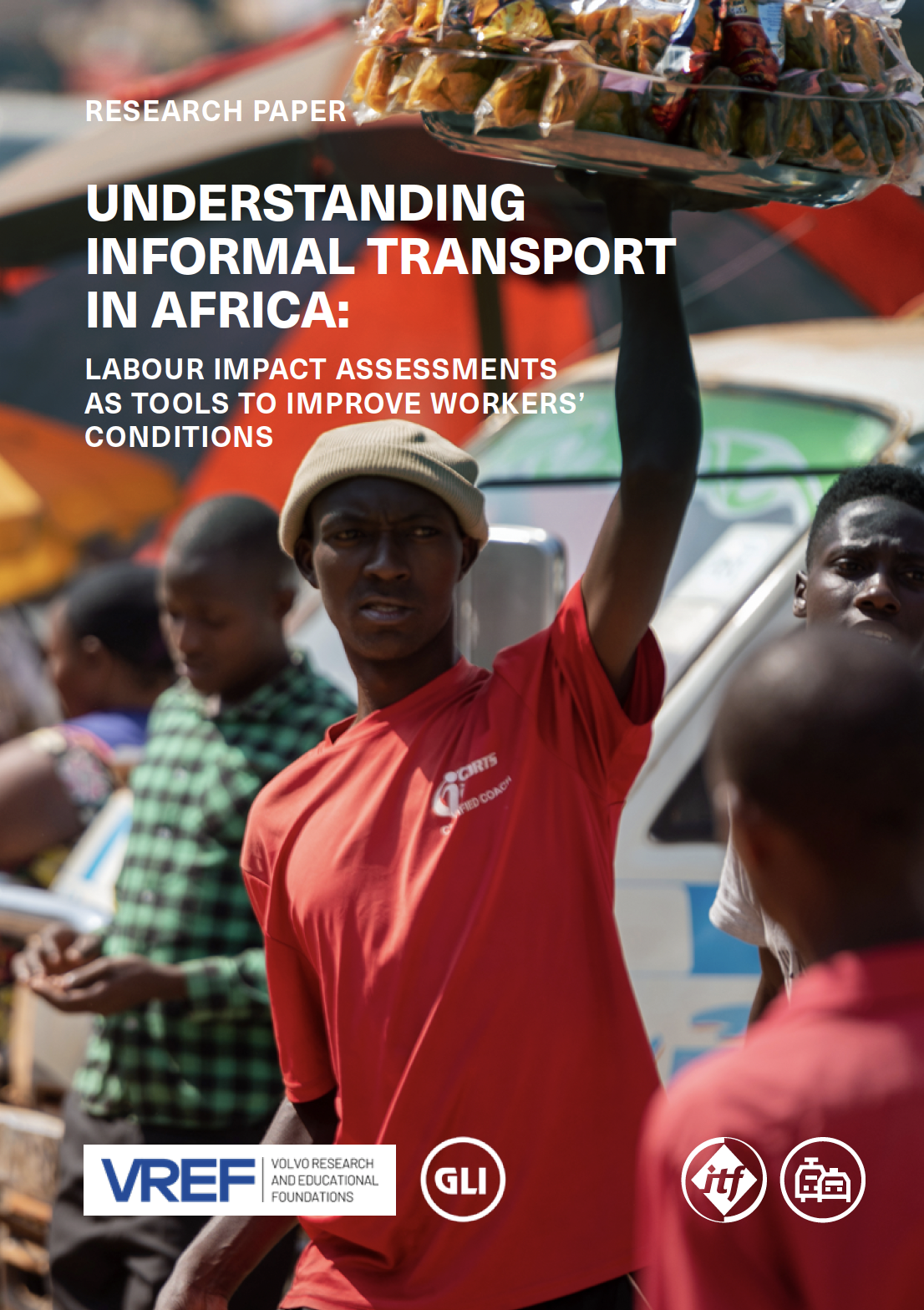
Understanding Informal Transport in Africa: Labour Impact Assessments as Tools to Improve Workers’ Conditions
Since 2010, the International Transport Workers’ Federation (ITF) and the Global Labour Institute (GLI) have been working on labour and employment issues in the informal transport industry, and have identified the urgent need to understand the current and potential future impact of Bus Rapid Transit (BRT) projects on employment. As a result, the ITF commissioned GLI to undertake a sequence of Labour Impact Assessments in Nairobi (2017–18), Dakar (2019) and Abidjan (2022). The GLI was also commissioned by Agence Française de Développement (AFD) in Kampala (2019–20), and Ghana Urban Mobility and Accessibility Project (GUMAP) in Accra (2021) to undertake research using the same methodology.
Labour Impact Assessments share key common characteristics:
- participatory research methods,
- innovative research tools,
- a broad and inclusive definition of ‘transport worker’ to include all those directly dependent on informal transport for their livelihoods,
- partnership with local academic institutions,
- support for constructive dialogue and negotiation between trade unions and transport authorities,
- Most importantly, they are based on the active participation of trade unions and workers’ associations representing informal transport workers.
In 2024, the Volvo Research and Educational Foundations (VREF), ITF and GLI recognised that there was an opportunity to review the research undertaken in all five cities, draw together some generalised findings and proposals that may have broader international value and relevance for public transport reform, review and document the participative research methodology that evolved through the sequence of projects, and identify opportunities for mainstreaming Labour Impact Assessments to improve workers’ conditions during public transport reform initiatives.
Download
Authors
Publication date
2025/01/27
Language
Available in English, Portuguese, Spanish and French – see https://tinyurl.com/59nxf2ur
Production
Global Labour Institute (GLI) Manchester, with support from the International Transport Workers’ Federation (ITF) and the Informal and Shared Mobility in Low- and Middle- Income Countries Research Program of the Volvo Research and Educational Foundations (VREF)
ISBN
More Publications
Informal and Shared Mobility – Status, Challenges, and Opportunities in Southeast Europe and Central Asia
Writing, Leading and Managing Research Proposals and Projects in Transport Studies – An Interactive Handbook for Students and Educators